I have a Le Bourget package on the top shelf of my hosiery closet that I have never opened. It is a 1970s Déesse stocking in cellophane, picked up at a Decatur thrift store maybe ten years ago for two dollars. The cellophane has yellowed. The printing on the back is in French and a little Spanish. The model on the front has the impossibly long legs of 1970s lingerie photography, set against a colored gel backdrop, and the wordmark, Le Bourget Paris in art-deco italics, is essentially the same one the company still uses today. That kind of visual continuity is increasingly rare.
Le Bourget was founded in 1924 by Joseph-Pépo Saltiel in Fresnoy-le-Grand, a small textile town in the north of France, with twelve workers and a stocking machine. By the postwar period it had become one of the major French hosiery houses. The brand introduced the first French nylon stockings in 1949, the first seamless stockings in 1961, and a fine-denier ladder-resistant pair called Têtu (Stubborn). The colored tight ranges they introduced in 1977 are probably what my yellowed thrift-store envelope belongs to. For roughly seventy-five years the brand was French in everything: design, manufacture, marketing.
Then, in September 1999, CSP International bought Le Bourget. CSP is an Italian publicly listed company headquartered in Castel Goffredo, in the province of Mantua. By the group’s own reckoning, this textile district produces two-thirds of the tights sold in Europe and a third of the tights sold worldwide. The neighboring town, Castiglione delle Stiviere, is where Golden Lady is headquartered. The pattern is becoming familiar: brand after brand in European hosiery quietly acquired by Italian groups based within twenty miles of each other in Lombardy. The work that used to be done in Fresnoy-le-Grand is now done in CSP’s own factories in Italy. The creative team is still in Fresnoy. The yarn count and the loom settings come from Mantua.
The product today is an interesting example of how a heritage brand can be kept alive without being embalmed. Le Bourget runs two parallel lines. The Satine collection covers the contemporary sheers and opaques at thirty denier and below, including a Satine Couture seamed pair that is a direct nod to the 1950s back-seam stocking my grandmother would have worn. The Heritage line, registered as a trademark in 2016, leans further into archive references and the Parisienne branding the company has been using since the 1930s. Prices in the UK run from about fifteen to thirty pounds for the everyday styles, with the heritage pieces sitting higher. Mid-premium, well below Wolford.
The most quietly impressive thing on the current Le Bourget site is what they call the Nude range. Where most hosiery brands still ship a single “beige” and call the problem solved, Le Bourget offers a graded set of nude tones meant to map onto a wider spectrum of skin colors. I have called out brands in this series for failing to do this. Le Bourget has done it. It is the kind of catalogue decision that does not get press coverage, because it is the absence of a problem rather than the presence of a feature, but it is one of the reasons the brand still feels current.


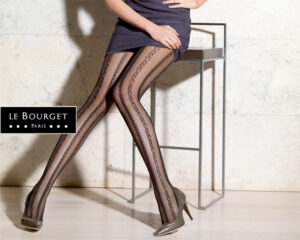



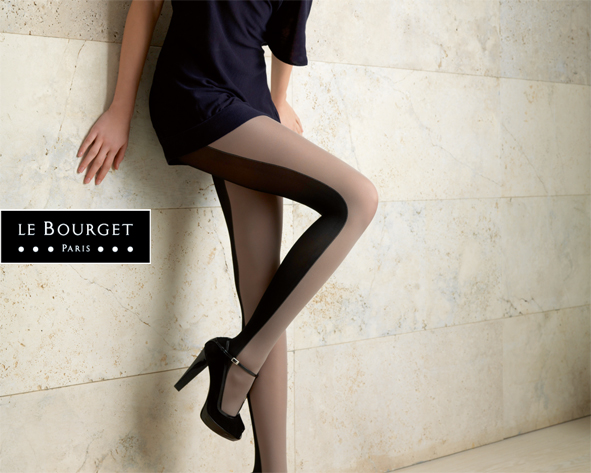
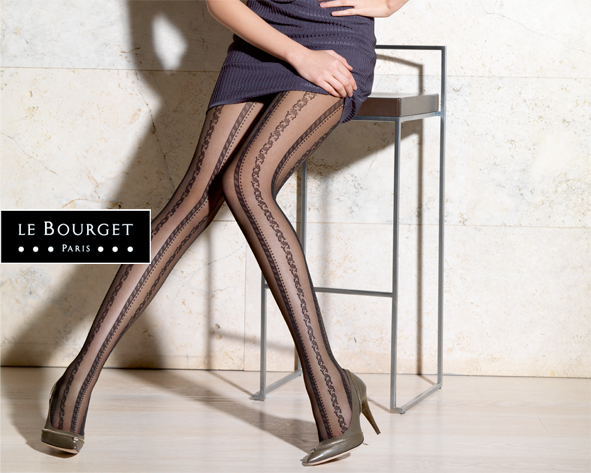


What is missing is a real U.S. presence. There is no American webshop. You can buy Le Bourget in the States through UK specialty hosiery sites that ship internationally, or piecemeal on Amazon through European resellers. A pair of Satine fifteen-denier at retail in the UK runs about seventeen pounds, which lands around twenty-three or twenty-four dollars by the time it arrives in Atlanta. That is fair for what you get, but it is not a regular-rotation purchase. The brand seems content for now to dominate France and let the rest of the world be a long-tail business.
If you find an old Déesse or Voilance in a sealed package on Etsy, those are also worth a look. The yarn weight is different from modern equivalents, in a way you have to feel to understand. My 1970s pair stays sealed for now. The new ones, the Le Bourget you can actually buy today, are the same brand in every way that matters. The wordmark is the same. The taste is the same. The factory is just three hundred miles east of where it used to be.





Leave a Reply